Course Outline: Download here
Class Timings and Venue: 11:00 a.m. to 12:15 p.m., Tuesday and Thursday
Class TA: Anamta Asif and Beenish Moazzam
This course was also offered in Spring 2021. You can access the structure of that course, alongwith digitally recorded videos of lectures here. The playlist for the year 2026 can be seen here.
Table of Contents
Describing the crystalline state (5 lectures)
 1: Symmetry operations Video
2: Developing point groups Video
3. Crystal systems and Bravais lattices Video
4. The idea of space groups Video
5. Example space groups and their interpretation Video
Homework number 1 and its its solution.
Resources
- Symmetry elements and symmetry operations by Dr. Saadat Anwar Siddiqi and Muhammad Sabieh Anwar
- Some Important crystal structures
- EPFL Switzerland had an online interactive Crystallography course. This is a wonderful resource for delving deeper into crystallography and will also motivate ideas for projects in computational physics.
- Nice tutorial on understanding the nomenclature of space groups and International Tables How to read (and understand) Volume 1 of International Tables of Crystallography, J. Appl. Cryst. 43 1150-1171 (2010), by Z. Dauter and M. Jaskolski.
- Nature Milestones on Crystallography
- Handout on point groups taken from “Solid State Physics” by Gerald Burns.
- Handout on space groups taken from the International Tables for Crystallography.
- Assorted space groups that will also help in the homworks.
- Handout on space groups for the most important cubic structures and the wurtzite structure also taken from the International Tables for Crystallography.
- Learning about point groups: check this wonderful resource at Otterbein University. We also use this in class to understand the symmetry operations associated with the various point groups.
- Download and test the self-explanatory software Crystalline Solids for visualization the seven crystal classes as well as close packing of atoms.
- A short book on the Structure of Crystals by the famous A. M. Glazer.
Diffraction and Crystal Structure Determination (5 lectures and 1 tour)
 1: Miller planes, directions and the reciprocal lattice Video
2: Bragg formulation of diffraction and the Ewald construction Video
3: Consolidating the concept of diffraction with some examples Video
4: This was a tour to the X-ray diffraction lab
5. Diffraction as Fourier transformation and the structure constant Video
6: Examples of structure constant and reflection conditions specific to crystal structure Video
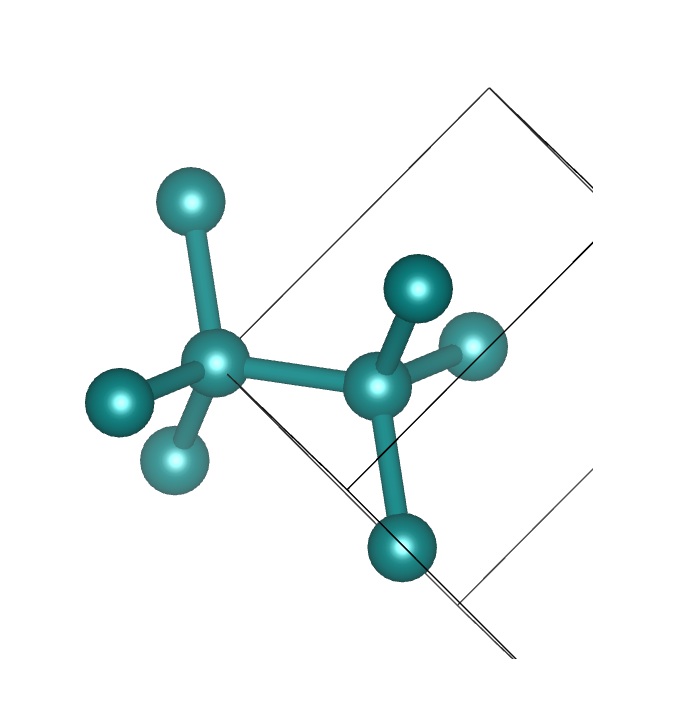
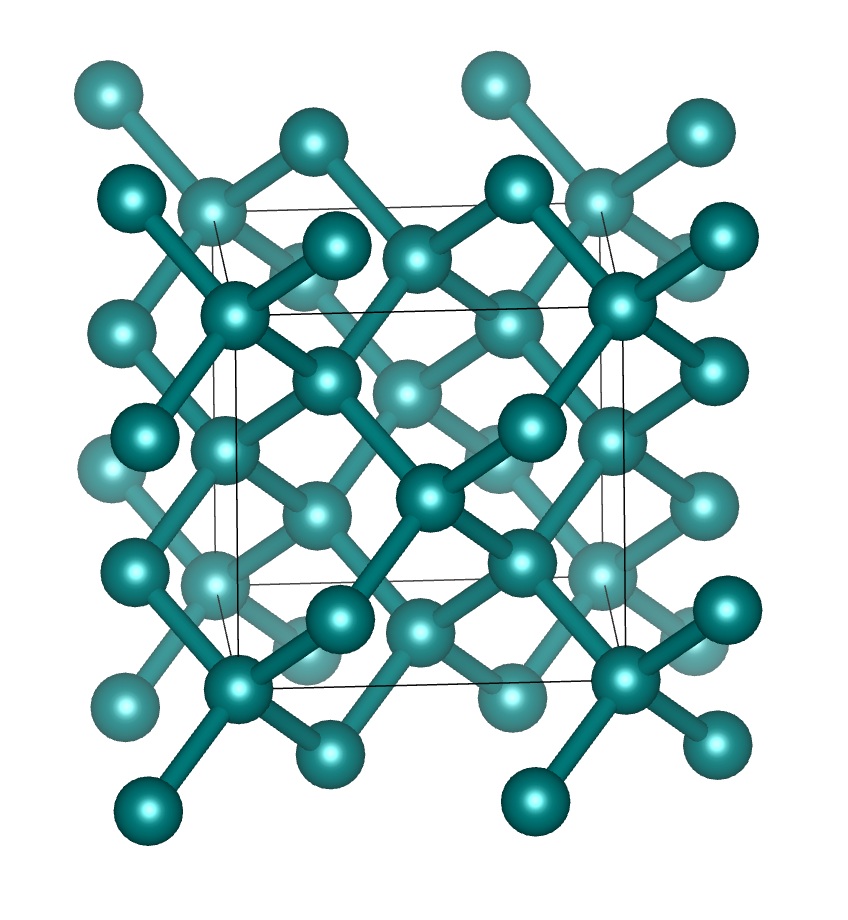
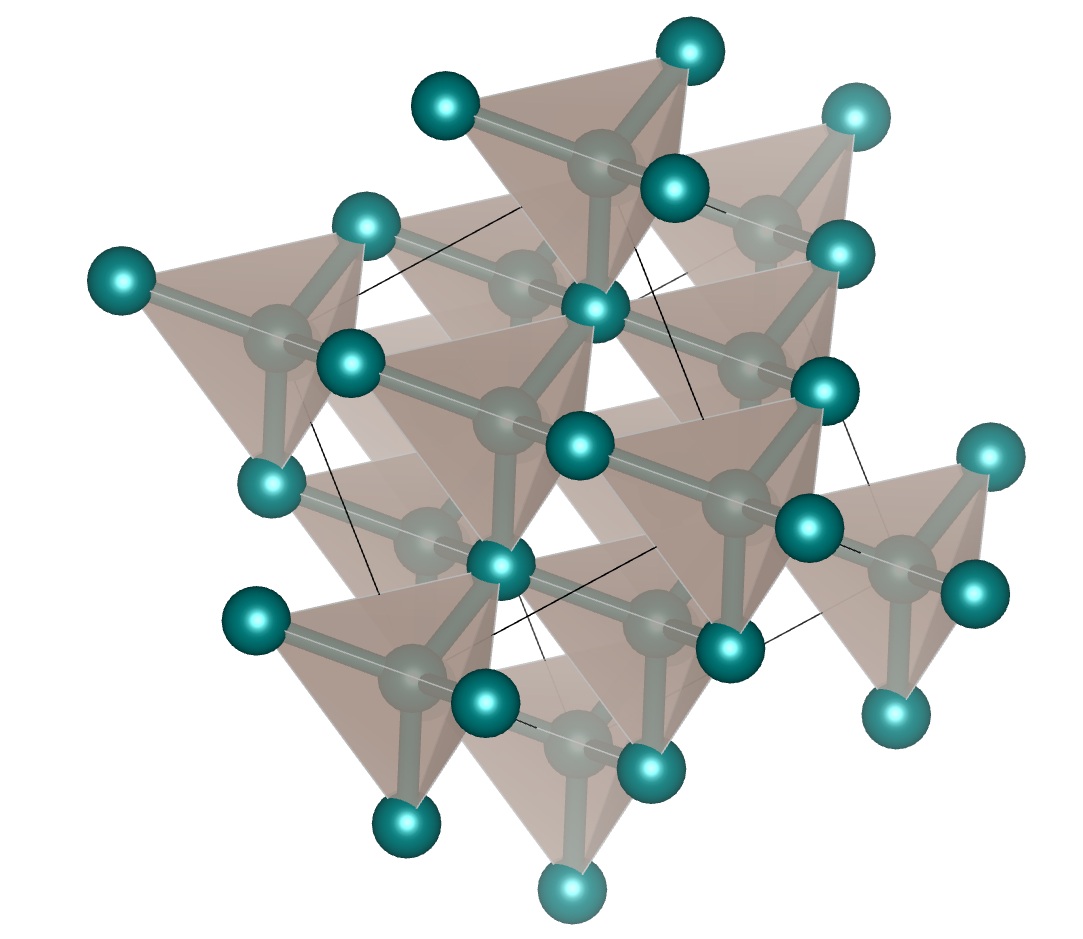
Homework no. 2 and its its solution. Note that solutions to Q3 and Q4 can be found here. I solved Q6 in class (lecture 5 above) and Q11 can be attempted through the software Vesta. A solution might look like this. Here are the two kinds of C atoms (Q2) indicating that they have different environments (orientations of the tetrahedrons). Also shown is the full structure of diamond in ball-and-stick mode. I ahve also created a display showing that each C atom is coordinated with four neighboring atoms that are arranged in a tetrahedron. Finally, here is homework no. 3 whose solution goes here.
Resources
- Values of sin(theta)^2 for diffraction peaks for some cubic structures: CsCl, Cu and Fe with P, F and I Bravais lattices, respectively. You can use this to practice some crystal structure determination (i.e. computing lattice parameters).
- Some plane spacings calculated for some crystal systems, taken from Introduction to Crystallography by C. Hammond.
- Here is a presentation that compiles XRD data from NaCl, Fe, ZnO, PbO, lithium carbonate, and CuO showing extracted lattice dimensions matched against standard results.
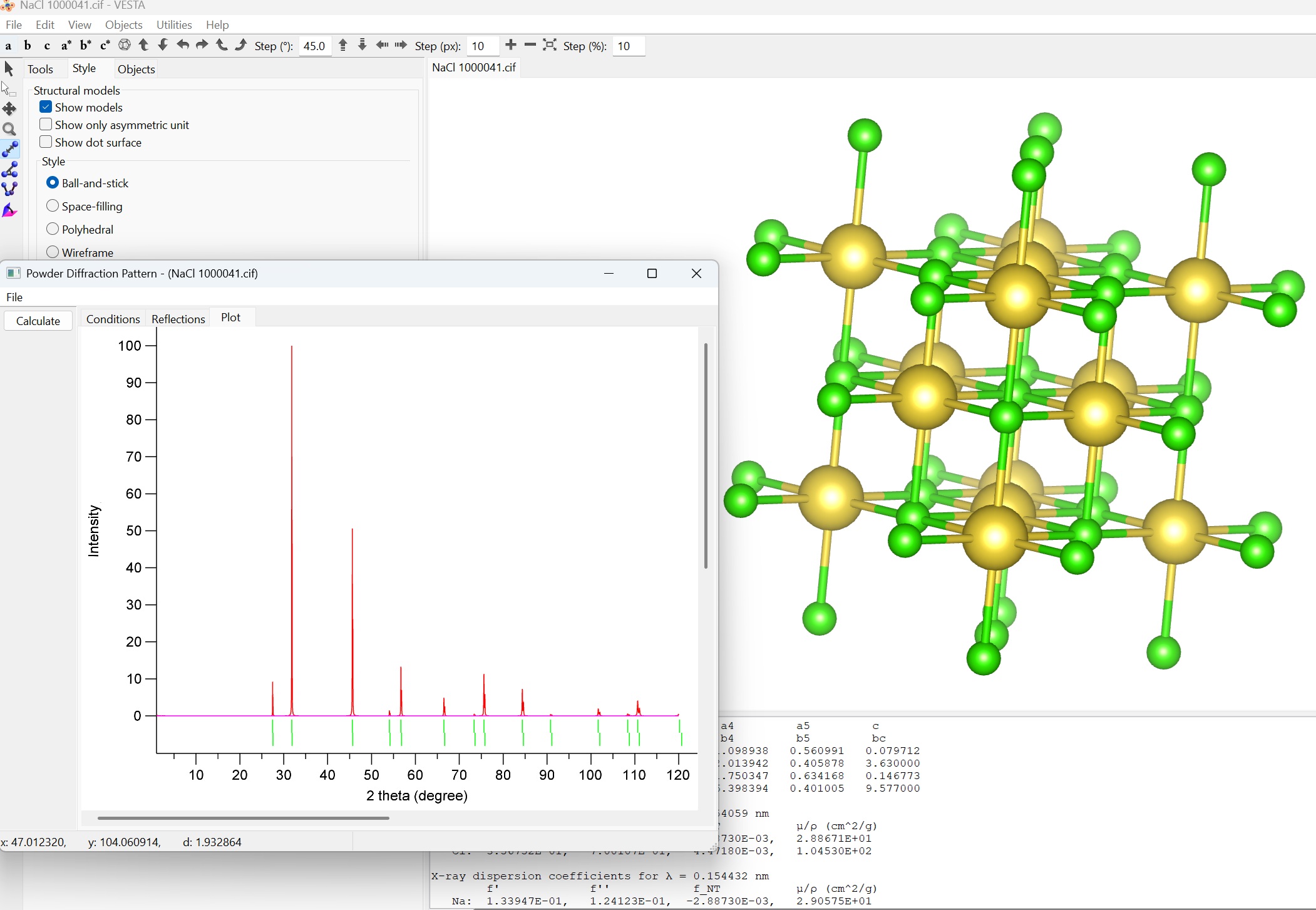
- I highly encourage the use of the freely available software called Vesta that helps visualize and construct crystal structures, show planes, directions, projections along various orientations, bonds and can compute bond lengths, angles and other distances. Vesta allows one to load CIF files from the Crystallography Open Database and then visualize and view the structure and also display the diffraction pattern. A screenshot is shown below.
Crystal Dynamics (6 lectures)
1: Equation of motion for vibrating atoms in a crystal Video
2: The concept of Brillouin zones Video
3: Idea of the phonon and calculation of heat capacities Video
4: Density of states and Einstein and Debye models Video
5: Phonons in two-dimensions Video
6: Quantizing the energy to derive the phonon model (second quantization approach) Video
In homework no. 4, I demand simple calculations to compute heat capacity given the quantized nature of oscillations. These are all semi-classical calculations. Also note that the midterm will take place on the 2nd of April, owing to the unfortunate closure of the university due to aggression on Iran, Lebanon and Palestine. If you are interested in seeing a solution to this homework, here it is.
Now, homework no. 5 has been prepared to provide you with another instance of an explicit calculation for phonon dispersion curves in 2D. Do attempt it! Finally, here is its solution.
Resources
- Read Solid State Basics Chapters 8, 9, 10 and Section 13.2.
- The discussion on phonons in 2D can be supplemented by some interesting examples. Very similar to the treatment we followed in lecture 15 (lecture 5 in this section), here is a nice tutorial on calculating dispersion relationships in 2D materials, exemplified by graphene. You can also download the pdf of a Mathematica file that calculates the dispersion relationship along high symmetry lines a 2D lattice. I have found Section 3.3 of the book Introduction to Solid-State Theory by O. Madelung to present a very clear treatment of phononic dispersion.
- Students need to be aware of the time-independent perturbation theory, both nondegenerate and degenerate. My personal favorite is Chapter 14 of Mark Beck’s book: Quantum Mechanics: Theory and Experiment. Alternatively, you can see my lectures on non-degenerate perturbation theory.
- The visualization of higher order Brillouin Zones is quite an interesting pastime or full-time hobby. Higher Brillouin Zones by Andrew, Salagaram and Chetty published in the European Journal of Physics.
- The midterm exam and its solution.
Free electrons (5 lectures)
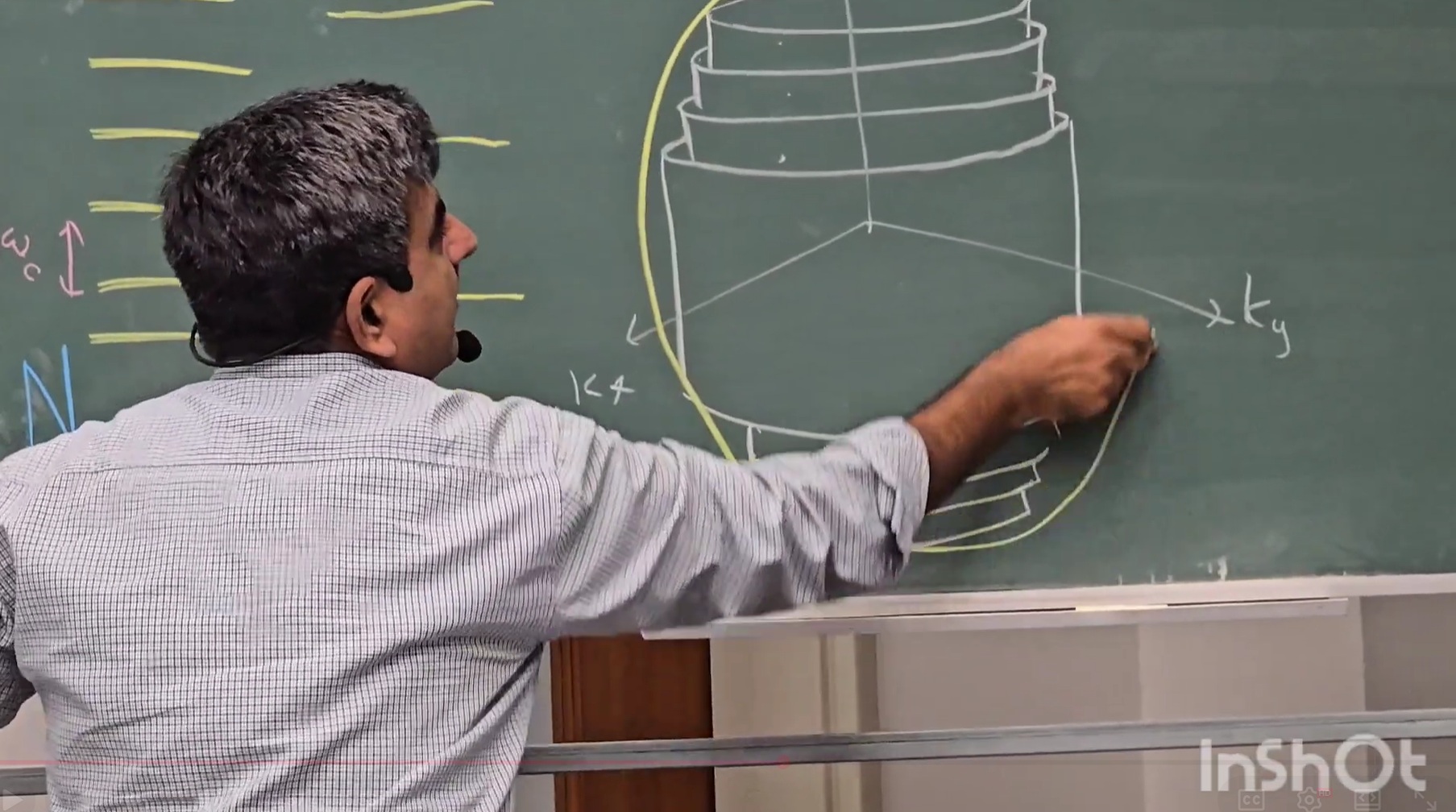 1: Free electrons and their k-space structure Video
2: The Sommerfeld expansion and some properties of free electrons Video
3: Landau quantization Video
4: Density of states in the presence of a magnetic field Video
5: Energy and Landau diamagnetism, magneto-oscillatory phenomena Video
Homework no. 6 will get you started with ideas relevant to free electrons and its solution is here.
Homework 7 is a bit more challenging though.
Resources
- Read Solid State Basics Chapters 3 and 4.
- In my opinion the best resource available to understand the Landau quantization phenomena and associated properties of electronic systems is found in Dresselhaus’s notes (part 3) on condensed matter physics on the MIT webpage.
- Sections 3.4 and 3.5 of Nolting and Ramakanth are a definitive standard in an analytical derivation of magnetic oscillations using the grand canonical ensemble approach. Furthermore, this compressed file contains a Mathematica notebook, its PDF version and a powerpoint file. The Mathematica notebook contains code for making plots of the various properties of the Landau quantized system. Also see these lectures notes by S. Teitel from the University of Rochester.
Selected transport properties (3 lectures) and the Band structure (2 lectures)
 1: Some basics of electrical transport in light of Drude’s model Video
2: Electron-phonon scattering mechanisms Video
3: Temperature-dependent transport Video
4: Motivating the existence of bands and energy gaps in crystalline solids Video
- See my collection of data on temperature dependent transport properties of selected elemental metals.
- Read Solid State Basics Chapters 15 and 16.
- I think I haven’t done justice to describing the Hall effect in class. Please look this up on your own.
- Here are some solved problems related to band structure: Problem Set A and its solution; Problem Set B and its solution